English
 Español
 Français
 Deutsch
 Українська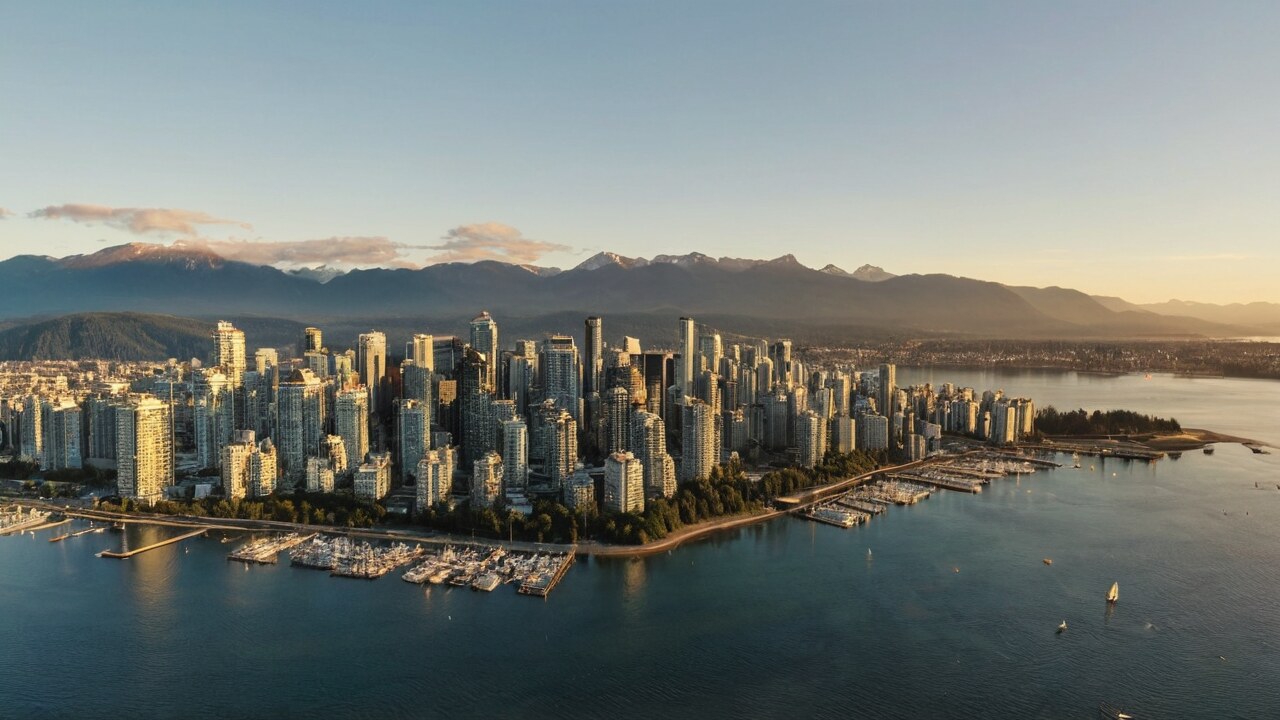
Most cities are founded on a river crossing or a gold vein. Vancouver was founded on a bet — several of them, stacked. That a talkative steamboat captain's whisky barrel could conjure a town out of a sawmill's edge. That a railway could be talked into ending here. That a settlement which burned to the ground nine weeks after incorporating could be worth rebuilding before the ashes cooled. Every bet paid. But to start the story in 1886 is to skip its longest chapter.
🛶 Ten thousand years before the city
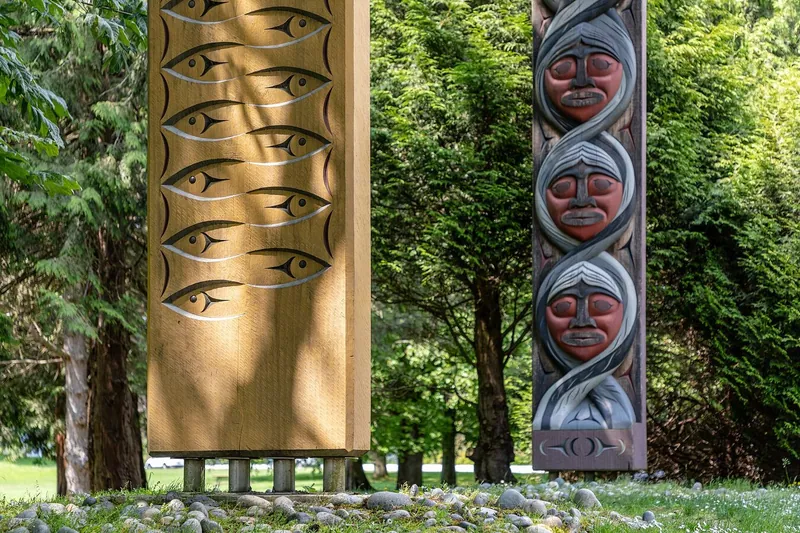
The shores of Burrard Inlet belong, in every sense that predates paperwork, to the xʷməθkʷəy̓əm (Musqueam), Sḵwx̱wú7mesh (Squamish) and səlilwətaɬ (Tsleil-Waututh) peoples — salmon nations whose villages, middens and stories are older than Rome. One of those villages, X̱wáý̓x̱way, stood inside what is now Stanley Park; its feast-shell middens were thick enough that early road-builders paved with them. When Captain George Vancouver sailed HMS Discovery into the inlet in June 1792 and gave the charts his name, he was — as the local joke goes — roughly ten millennia late to the discovery. The city today formally acknowledges it stands on unceded territory: land never signed away by treaty. The nations are not historical footnotes; they are landowners, developers and cultural forces in the modern city — and the oldest stories on this coast are theirs, some retold in our Legends of Vancouver.
🥃 A saloon, a fire, a railway
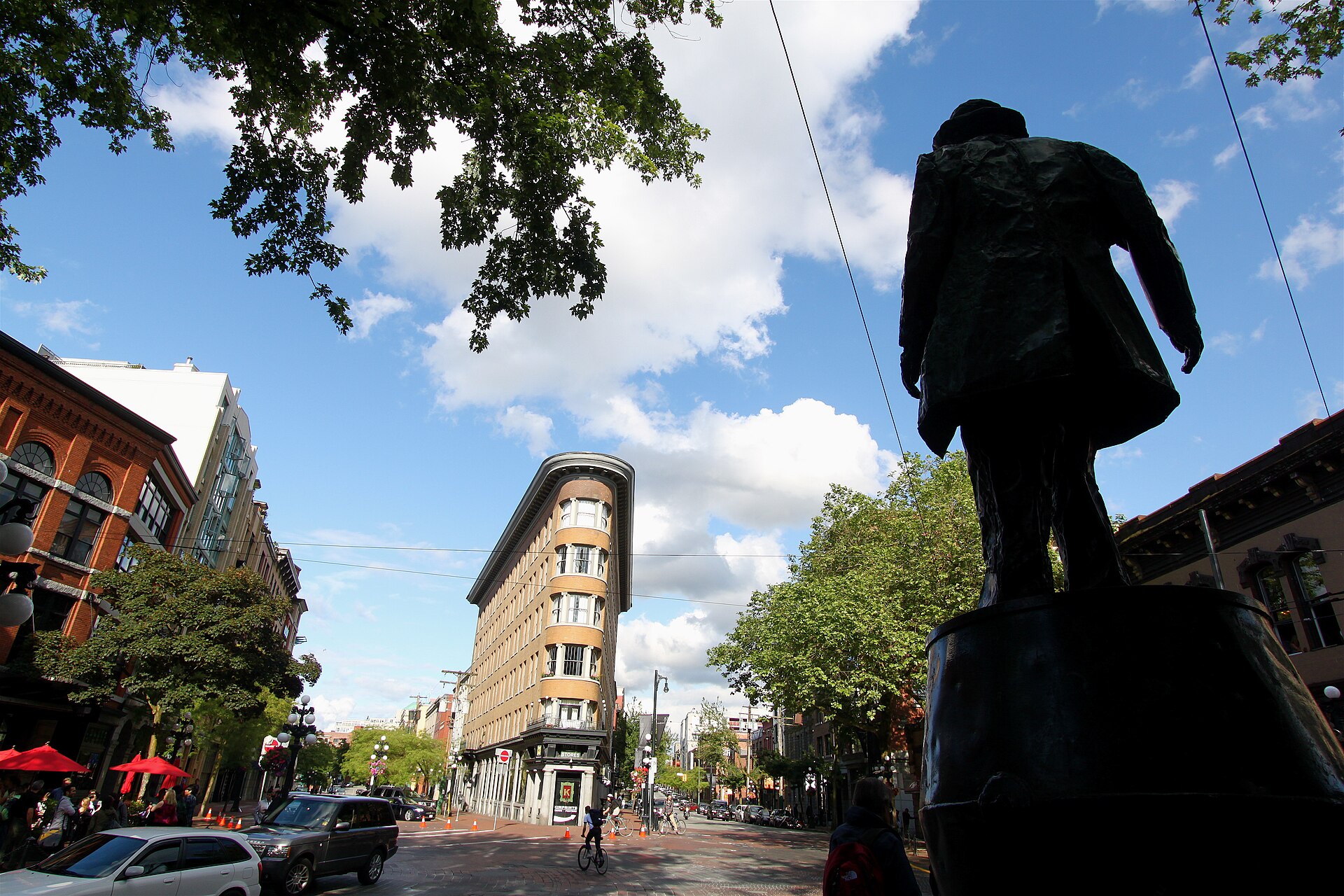
The short version of the founding: in 1867 John 'Gassy Jack' Deighton offered mill workers a barrel of whisky to build him a saloon, and 'Gassy's Town' materialized around it — the brick district still called Gastown. The colonial government tidied the name to Granville; the Canadian Pacific Railway untidied everything by choosing the spot as its Pacific terminus. On 6 April 1886 the city incorporated — renamed Vancouver at railway boss William Van Horne's insistence, because a name already on the world's charts sold tickets. Nine weeks later the Great Fire deleted the entire wooden town in well under an hour. The survivors held a council meeting in a tent and started over; the first transcontinental passenger train rolled in on 23 May 1887, and the bet was won. From about a thousand people to a global port city in one human lifetime.
Stand in today’s Gastown and you are standing inside that bet’s first geometry — saloon town become brick warehouse district. A short walk east reaches Chinatown, founded in the same railway decade by the communities who cut the hardest mountain miles and then built a commercial home the city tried, repeatedly, to shrink. The founding narrative is not only Gassy Jack and a CPR timetable; it is also who was invited to stay when the trains arrived. For the folklore-sized versions — fire, cannon, Siwash Rock — keep Legends of Vancouver open in another tab.
🌏 Who actually lives here
Modern Vancouver's defining statistic isn't its skyline or its rain — it's this: 54% of Metro Vancouver residents identify as visible minorities, and roughly half the region grew up speaking something other than English at home. The 2021 Census counts about 512,000 residents of Chinese origin (19.6% of the region — one of the great Chinese communities outside Asia, anchored by a Chinatown founded in the 1880s) and about 369,000 of South Asian origin (14.2%) — the Punjabi Market on Main Street is one of North America's oldest South Asian commercial districts, and Surrey's Vaisakhi parade draws hundreds of thousands, among the largest outside India.
Honesty requires the hard chapters too: the head tax on Chinese migrants who built the railway's most dangerous miles; the 1914 Komagata Maru, a ship of 376 mostly Sikh British subjects anchored in this harbour for two months and turned away; the wartime internment of Japanese Canadians whose Powell Street neighbourhood never recovered. The city has formally apologized for all three. Today's Vancouver — where a quarter of the city is of Chinese heritage, where Punjabi is heard in the Legislature, where the sushi rivals Tokyo's and the dim sum needs no qualifier — was built by the very communities the old city tried to keep out. That reversal is the real story of the place.
⚓ The city that Hollywood, Greenpeace and the ocean built
The numbers that run the modern city: Canada's largest port moves roughly $300 billion in goods through Burrard Inlet and the Fraser; Hollywood North keeps more film crews working than anywhere in North America outside LA and New York; and the mildest big-city climate in Canada lets the same person ski a local mountain and walk a beach in the same afternoon — the geography that keeps Vancouver a fixture in global liveability rankings even as it tops the un-affordability ones. Two facts locals drop with equal pride: Greenpeace was founded here in 1971 in a Dunbar living room, and Chinatown's Sam Kee Building at 1.5 metres deep is certified the world's shallowest commercial building — a landlord's spite made architecture. Both, in their way, very Vancouver: stubbornness with a view.
📊 The numbers, at a glance
| City of Vancouver population (2021 Census) | 662,248 |
| Metro Vancouver (21 municipalities, 2021) | 2,642,825 |
| Residents of Chinese origin (Metro) | 512,260 · 19.6% |
| Residents of South Asian origin (Metro) | 369,295 · 14.2% |
| Visible minorities (Metro, 2021) | 54% |
| Incorporated / Great Fire / first CPR train | Apr 1886 / Jun 1886 / May 1887 |
| Rank among Canadian metros | #3, after Toronto & Montreal |
Population and origin figures: Statistics Canada, 2021 Census of Population.
❓ Vancouver basics — FAQ
What is the population of Vancouver?
At the 2021 Census: 662,248 in the City of Vancouver and 2,642,825 in Metro Vancouver (the region of 21 municipalities most people mean when they say 'Vancouver'). Recent estimates put the metro area near three million — it is Canada's third-largest urban area, after Toronto and Montreal.
When was Vancouver founded?
The city was incorporated on 6 April 1886 — and burned almost completely to the ground nine weeks later, on 13 June 1886, then rebuilt immediately. Its practical origin is older: Gassy Jack Deighton's 1867 saloon that seeded Gastown. And human history here is older by millennia — the Musqueam, Squamish and Tsleil-Waututh peoples have lived on these shores for thousands of years.
Why is Vancouver called Vancouver?
After Captain George Vancouver, the British navigator who charted Burrard Inlet in 1792. The name was chosen in 1886 at the urging of CPR executive William Van Horne, who wanted a name the world would recognize for his railway's new Pacific terminus.
How many Indian and Chinese residents does Vancouver have?
Per the 2021 Census, Metro Vancouver is home to about 512,260 residents of Chinese origin (19.6% of the region) and 369,295 of South Asian origin (14.2%) — among the largest such communities in North America. Overall, 54% of Metro residents identify as visible minorities, and about half speak a first language other than English.
Is Vancouver expensive to live in?
Yes — it consistently ranks among North America's least affordable housing markets, a fact locals discuss the way other cities discuss weather. For visitors the picture is kinder: see our real daily budgets and the live rental price tracker.
Now meet the city in person
The stories behind these facts live in Legends of Vancouver; the practical city is in things to do, getting around and the real cost of a day here.