English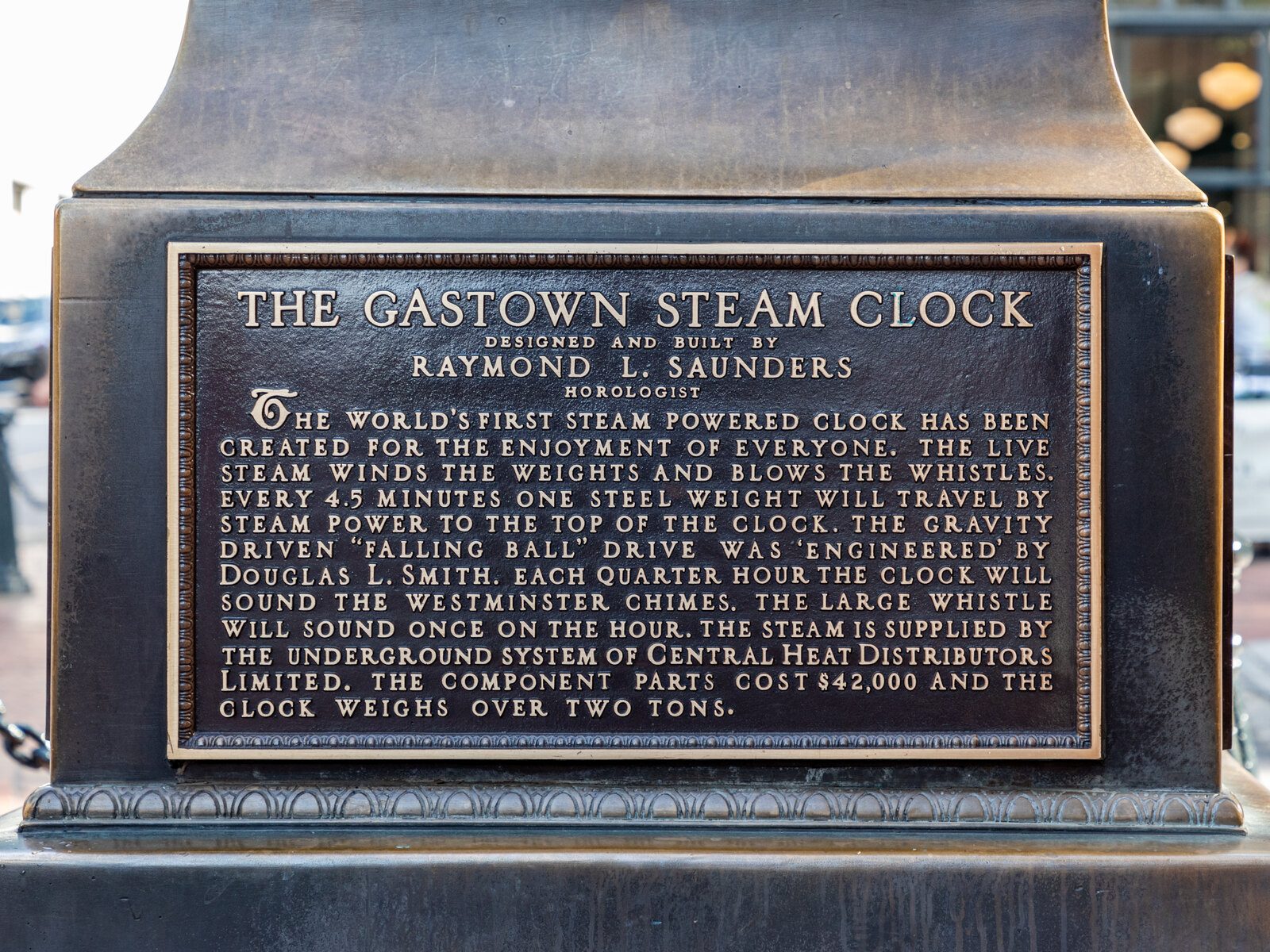
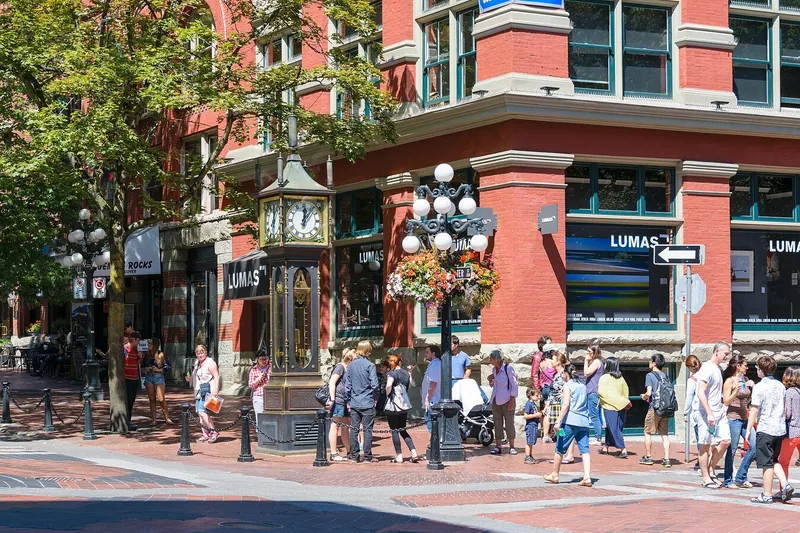
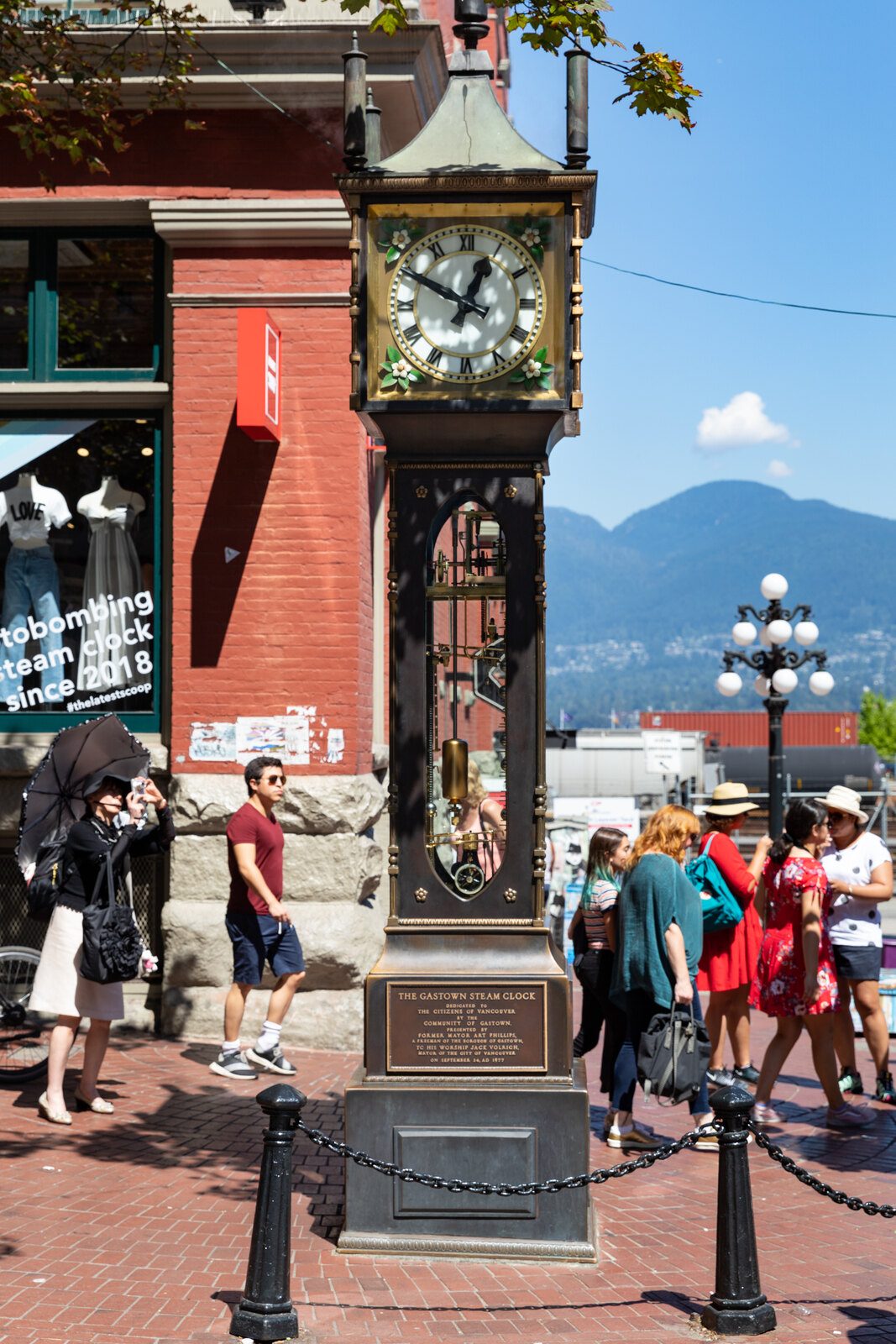
Every few minutes a crowd forms on the corner of Water and Cambie, phones up, waiting. The clock hisses, the whistles play the Westminster chimes, steam goes up into the wires, and around fifty people take the same photograph. Then a guide says something like "and it has been keeping time here since the Victorian era," and everyone nods.
It was built in 1977.
What it actually is
In the mid-1970s Gastown was being rescued. The neighbourhood had been slated for a freeway a few years earlier, the heritage designation had just landed, and the city was dealing with a specific, unglamorous problem: a steam vent in the sidewalk on Water Street. Vancouver has a district steam-heating system — pipes under downtown carrying steam from a central plant to heat buildings — and the grates where it escapes attracted people sleeping rough. The city wanted the grate covered with something that would also stop the corner looking derelict.
The commission went to Raymond Saunders, a Vancouver horologist. He designed the case in a deliberately Victorian idiom, because the buildings around it are Victorian and a modern box would have looked like an insult. He has said as much: the design was meant to match its neighbours, not to fool anyone. The clock movement was inspired by an 1875 British tower clock design. The steam engine inside is the sort of small unit sold to hobbyists for powering large model boats, made in England.
It was finished in 1977, and it worked in the way people assume it still works: steam lifted the weights that drove the mechanism.
The part nobody mentions on the tour
Steam turned out to be a terrible way to run a clock. The pressure varies with demand on the heating network, and a clock that speeds up when an office tower turns its heat on is not a clock. The hands are now driven by an electric motor. The steam is real — it comes from the same municipal system — and it still blows the whistles on the quarter hour and the big whistle at the top of the hour. But the timekeeping is electric.
So: a real steam vent, a real 1977 clock, real steam whistles, and hands turned by a motor. It is genuinely one of the very few working steam clocks in the world. It is also not a Victorian antique, and the annoyance of the people who point this out is entirely earned — a CBC piece marking its fortieth birthday in 2017 quoted a local comedian on exactly this, that countless tourists leave thinking they have seen an ancient device.
Raymond Saunders
Saunders was born on 7 February 1940 and died on 23 November 2024, aged 84. The Gastown clock made his name and he went on to build six more public steam clocks, including one in Otaru, Japan (1994) and one for the Indiana State Museum (2002). He spent decades maintaining the Gastown clock himself, and for most of that time he was the only person in Vancouver who knew how to.
If you visit now, you are looking at the work of a man who died two years ago, not at a relic from before the city was incorporated. That is a better story, and it is the true one.
Practical: when it whistles and where to stand
| What | When |
|---|---|
| Small whistles — Westminster chimes | Every quarter hour |
| Large whistle — the one people wait for | On the hour, once per hour struck |
| Best light for photographs | Blue hour, roughly 20 minutes after sunset |
| Cost | Free, permanently, it is on a public sidewalk |
The corner is small and gets genuinely crowded between about 11 a.m. and 4 p.m. from June through September, and in December when the cruise-and-market traffic overlaps. Two things help. First, stand on the north side of Water Street, across from the clock: you get the steam against the brick facades instead of against parked cars, and you are out of the scrum. Second, come at the top of the hour rather than a quarter past — the big whistle is the only part worth timing your walk around.
It is a two-minute walk from Waterfront Station, which is the terminus of the Canada Line, the Expo Line, the SeaBus and the West Coast Express, so it costs you nothing to detour past it on the way to anything else in Gastown.
While you are on that block
The Old Spaghetti Factory at 53 Water Street is 200 metres east and contains a 1904 streetcar that four separate ghosts are said to use. Maple Tree Square, where Gastown started, is another two minutes past that. The whole documented origin of the neighbourhood — a saloon built in a day in 1867 — happened within sight of where you are standing.
Frequently asked questions
Is the Gastown steam clock really powered by steam?
Partly. The whistles are genuinely driven by steam from Vancouver's district heating system. The hands are turned by an electric motor, because steam pressure varies with demand on the network and made the clock inaccurate.
How old is the Gastown steam clock?
It was built in 1977 by horologist Raymond Saunders. It is designed in a Victorian style to match the surrounding heritage buildings, which is why it is so often mistaken for a nineteenth-century object.
Why was the steam clock built?
To cover a steam vent in the sidewalk on Water Street and to give the corner something to look at during Gastown's 1970s heritage restoration.
What time does the steam clock whistle?
Westminster chimes on every quarter hour, and the large whistle on the hour. There is no schedule to check — it runs continuously.
Who built the Gastown steam clock?
Raymond Saunders (1940–2024), a Vancouver clockmaker who built six more public steam clocks around the world, including in Otaru, Japan and at the Indiana State Museum.
Is it worth visiting?
It costs nothing and it is two minutes from Waterfront Station, so yes as a stop rather than a destination. Time it for the top of the hour and stand across the street.
Sources
- CBC — Creator of Vancouver's Gastown steam clock dies (November 2024)
- CBC — Revered and reviled: the Gastown steam clock turns 40 (2017)
- Wikipedia — Raymond Saunders (clockmaker)
Where accounts conflict, we say so in the text rather than picking the more dramatic version.
Photo: Dietmar Rabich, CC BY-SA 4.0 · Photo: dronepicr, CC BY 2.0