English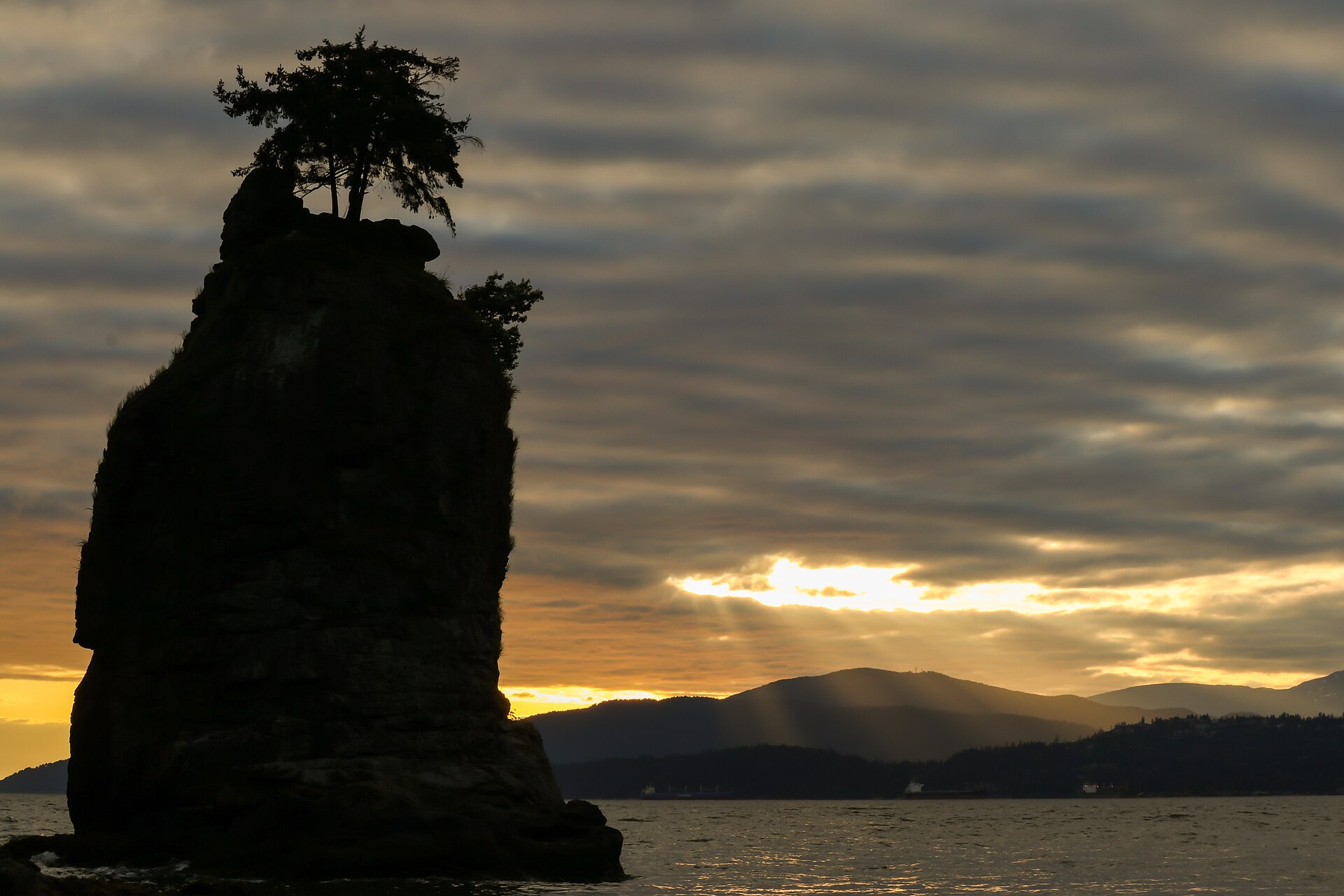
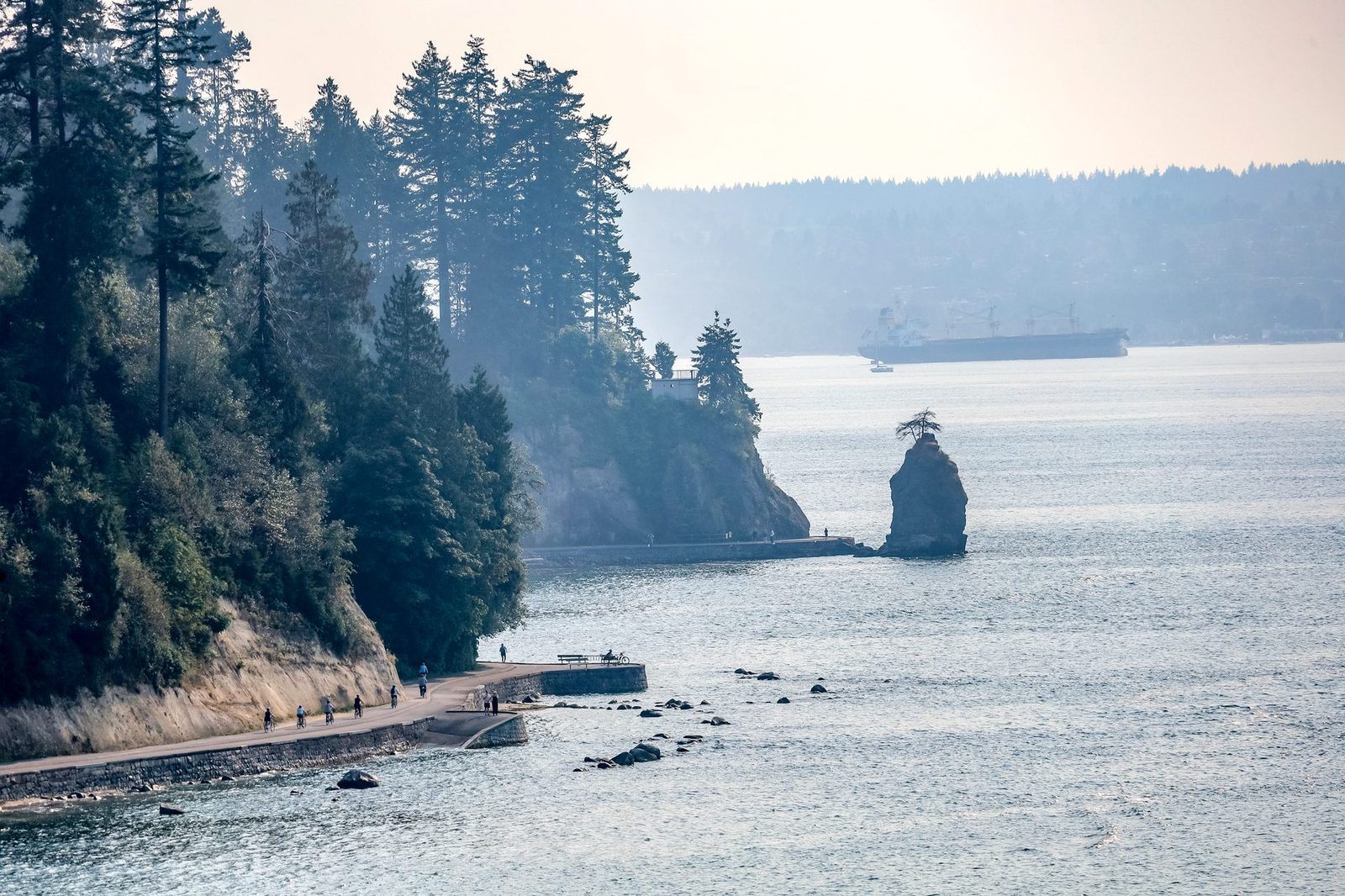
You come around the corner of the seawall past Third Beach and there it is, standing in the water a few metres off the cliff: a column of dark rock about the height of a five-storey building, with a small tree growing out of the top of it like a bad haircut. Everyone stops. Almost nobody knows what they are looking at.
Two answers exist, and they are both true, which is the interesting part.
The story, as Mary and Joe Capilano told it
The rock is a man. His name, in Sḵwx̱wú7mesh, is Slhx̱í7lsh, and the version most people have read is the one E. Pauline Johnson published in 1911 after hearing it from Chief Joe Capilano and his wife Mary Agnes Capilano.
In the telling, a young man learns his wife is about to give birth. By the law he lives under, a father must make himself clean before his child arrives — not tidy, but ritually clean, scrubbed of everything that came before, so that the child begins its life unencumbered. So he swims. He is still swimming, out in the narrows, when the canoe of the X̱ays — the transformers, the four brothers who go through the world changing things into what they ought to be — comes down the inlet and orders him aside.
He refuses. Not out of pride: he cannot stop, because stopping would leave the work unfinished and the child would carry what he had not washed away. He tells them so, and keeps swimming.
The transformers could have destroyed him. Instead they made him permanent. Johnson's line is that he was set there "as an indestructible monument to Clean Fatherhood" — and the Park Board plaque near the viewpoint still uses a version of that phrasing, naming him "Skalsh the unselfish."
Note what the story is actually about. It is not a punishment. It is not a warning. It is a man rewarded for refusing to interrupt an act of care, and the reward is that everyone who comes around that corner of the seawall for the next several thousand years has to look at him. There is a smaller rock beside him in some tellings — his wife and child, placed where he can see them.
The geology, which is older and stranger
The rock is a basalt sea stack. Roughly 32 million years ago, magma pushed up through the sedimentary rock that makes up most of the Stanley Park bluffs and cooled inside it as a hard vertical dike. Sandstone and mudstone erode at the speed of weather. Basalt does not. The sea has spent the intervening time removing everything around the dike and leaving the dike standing, which is why it looks placed rather than grown.
It is 15 to 18 metres tall depending on where you measure from, and the same intrusion runs into the cliff behind it — if you look up and left from the seawall you can see the darker rock continuing inland. The rock and the man are, in the most literal sense, the same object described by two different sciences.
The tree on top
A Douglas fir grew out of the crown of the rock for generations and became part of every photograph taken of it. It died in the drought summer of 1965. Park officials said publicly that nothing would grow back — there is essentially no soil up there. Within three years, seedlings had taken. The tree you are looking at now is the replacement, and it is smaller and scrappier than the one your grandparents photographed.
About the name
"Siwash" entered Chinook Jargon — the trade language of this coast — from the French sauvage. Inside the jargon it was simply the word for an Indigenous person; carried into English it did what that etymology suggests it would do. In 2017 a Vancouver Park Board commissioner formally proposed renaming the landmark Slhx̱í7lsh. The change has not been made, the maps still say Siwash Rock, and the signage is inconsistent. Locals use both. If you are writing about it, using both is the honest option.
How to actually get there
It is on the seawall on the west side of Stanley Park, between Third Beach and Prospect Point, and there is no charge for anything. Two approaches:
- From Third Beach — about 10 minutes north on the seawall, flat the whole way. This is the shortest walk and the best light in the evening, because the rock faces west and the sun goes down behind it. Bus 19 to Stanley Park Loop, then the trail down, or park at Third Beach (paid, and it fills on summer weekends).
- From the Prospect Point lookout — there is a stairway down through the trees to the seawall that most visitors walk straight past. Steeper, shaded, and quiet even in August.
The seawall at this stretch is one-way for cyclists (counter-clockwise) and the walking path is separate. It is the single most photographed 400 metres of the park, so if you want it without a crowd, go before 9 a.m. or in the rain — in the rain the basalt goes black and it looks considerably more like a man.
While you are there: Pauline Johnson's grave is about fifteen minutes further along at Ferguson Point, marked by a stone monument near the Teahouse. It is the only burial Stanley Park has ever allowed. She asked to be put where she could hear the water.
Frequently asked questions
What is the Squamish name for Siwash Rock?
Slhx̱í7lsh, also written Lhilhx̱í7elsh. It refers to a man transformed by the X̱ays, the transformer brothers. A Park Board commissioner proposed making it the official name in 2017; the change has not been made.
How old is Siwash Rock?
The basalt is roughly 32 million years old. It formed when magma intruded into the softer sandstone and mudstone of the Stanley Park bluffs and then cooled. The sea stack shape is much younger — it is what was left after erosion took the soft rock away.
How tall is Siwash Rock?
Between 15 and 18 metres, roughly 50 to 60 feet, depending on the tide and where you measure from.
Can you climb Siwash Rock?
No. It stands in the water off the seawall, the basalt is loose at the top, and there is no legal or safe access. It is also a culturally significant site to the Sḵwx̱wú7mesh. Look at it from the seawall.
Is the tree on top the original one?
No. The original Douglas fir died during the dry summer of 1965. Park staff expected nothing to replace it, but seedlings rooted within three years. What you see now grew after 1968.
Where is Pauline Johnson buried?
At Ferguson Point in Stanley Park, about fifteen minutes' walk north along the seawall from Siwash Rock, near the Teahouse. Hers is the only burial the park has ever permitted.
Sources
- E. Pauline Johnson, Legends of Vancouver (1911) — "The Siwash Rock"
- Wikipedia — Siwash Rock (geology, the 1965 tree, the 2017 renaming proposal)
- Vancouver Park Board — Stanley Park seawall
Where accounts conflict, we say so in the text rather than picking the more dramatic version.