English
 Español
 Français
 Deutsch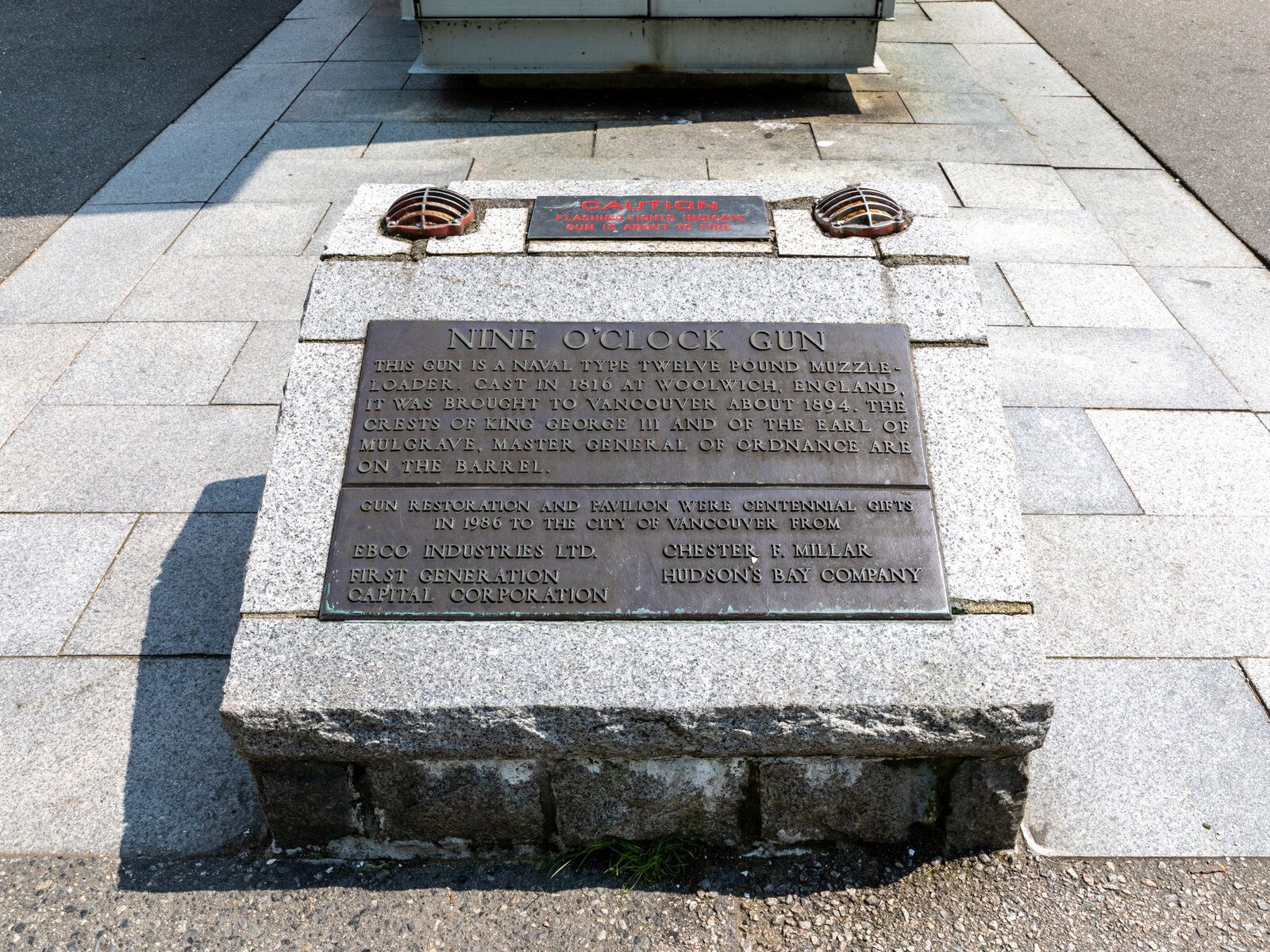
If you are anywhere near the water in Vancouver at nine in the evening, you will hear it: one flat, heavy report off Brockton Point that rolls across Coal Harbour and comes back off the downtown towers a beat later. Visitors look up. Nobody local reacts at all, which is its own kind of information about how long this has been going on.
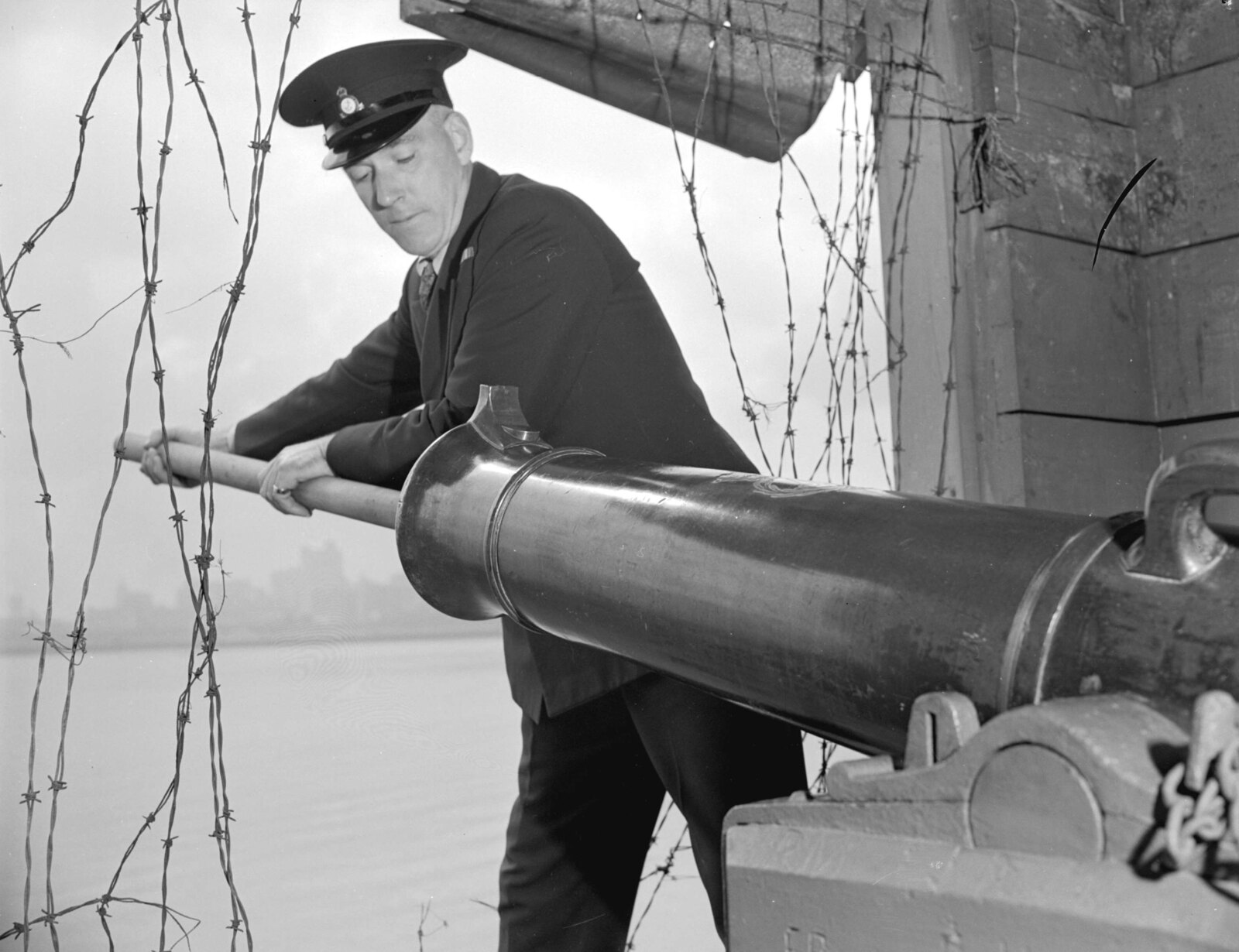
The object itself
It is a twelve-pounder muzzle-loading naval cannon, cast at the Royal Arsenal in Woolwich, England, in 1816. That date is worth sitting with. The gun was made the year after Waterloo. It is seventy years older than the city it now belongs to, older than the province, older than Confederation. It was a working piece of naval ordnance for most of a century before anyone thought of using it as a clock.
Before the gun, dynamite
The best detail in this whole story is the one that predates the cannon. The keeper of the Brockton Point light, William D. Jones, marked the hour by detonating a stick of dynamite over the water.
Read that again, because it is not a joke and it was not considered eccentric. There were fishing boats and coastal traffic in the inlet that needed a time reference, and a man with a lighthouse, a supply of explosive and a sense of duty provided one. The cannon was, among other things, a safety improvement.
Why it was put there
The gun came to Stanley Park around 1894, sent by the federal Department of Marine and Fisheries. Its original job was regulatory: it announced six o'clock on Sunday evening, the moment the weekly close of fishing began. A boat still hauling after the bang was breaking the law, and could not claim it had lost track of the hour.
The first firing in the park is recorded as 15 October 1898 — at noon, not at nine. The nine o'clock slot came later, when the firing was reworked into a general time signal: useful to the public, and genuinely useful to ships in the harbour, whose navigators needed a known-accurate moment to set a chronometer against. Before radio, a loud noise at a precisely known second was a public utility.
So when a guide tells you it was for the fishermen and another tells you it was for the chronometers, they are both right, and neither has the whole thing. The gun changed jobs. That is usually the shape of these stories — the test we set out on the legends hub is not "which version is true" but "which version is from which decade."
How it fires now
Nobody stands over it with a match. The gun is fired electrically: a telegraph operator closes a circuit at nine, and a blank charge goes off. There is no projectile and there has not been for a very long time.
It sits in a locked steel cage, which is not decorative. The gun has been interfered with often enough over the decades — student stunts, mostly — for the Park Board to decide it should be enclosed.
It is silent occasionally: technical faults, and deliberate suspensions to mark a death or a day of mourning. At midnight on 31 December it fires to bring in the new year, which is the one night of the year when the crowd is there specifically for the gun.
Going to hear it
Brockton Point is on the northeast side of Stanley Park, about a twenty-five-minute walk along the seawall from Coal Harbour or a ten-minute walk from the bus loop at the totem poles. The gun sits in a small stone emplacement just below the seawall path, signposted, and you can walk right up to the cage.
Standing next to it at nine is loud, and children who were not warned will not enjoy it. The better experience is from across the water. From the Coal Harbour seawall near the Convention Centre you get the report and then the echo off the buildings behind you, about a second apart, which is the version that actually sounds like a nineteenth-century harbour.
Combine it with the rest of the park's stories: the seawall west of here runs past Siwash Rock, and the wooded island you pass between Coal Harbour and Brockton is Deadman's Island. Our Stanley Park guide has the full loop.
Frequently asked questions
What time does the Vancouver 9 O'Clock Gun fire?
Every night at 9 p.m., from Brockton Point in Stanley Park, plus a firing at midnight on 31 December. It is occasionally silenced for technical faults or as a mark of mourning.
How old is the 9 O'Clock Gun?
The cannon is a twelve-pounder cast at Woolwich, England, in 1816 — seventy years older than the City of Vancouver. It was brought to Stanley Park around 1894 and first fired there on 15 October 1898.
Why does Vancouver fire a cannon at 9 p.m.?
It started as a signal to fishermen for the six o'clock Sunday close of fishing, then became a general time signal — a precisely known moment that ships in the harbour could use to set their chronometers. Both explanations you will hear are correct for different periods.
Is the 9 O'Clock Gun loaded?
It fires a blank charge, triggered electrically by a telegraph operator closing a circuit. No projectile is involved, and the gun sits in a locked cage.
Where is the best place to hear it?
Up close at Brockton Point if you want the impact; from the Coal Harbour seawall near the Convention Centre if you want the report followed by the echo off the downtown towers, which is the better sound.
Sources
- Wikipedia — 9 O'Clock Gun
- Vancouver Heritage Foundation — Heritage Site Finder, Brockton Point
- City of Vancouver Archives — Stanley Park photographic collections
Where accounts conflict, we say so in the text rather than picking the more dramatic version.
Photo: Dietmar Rabich, CC BY-SA 4.0 · Photo: Coltman, Don (Photographer) Steffens Colmer (Photographer), Public domain